









Opinion by Gerard Grobler/ Whalecoastreport]
Every election cycle in the Overstrand follows a familiar, comfortable script. Candidates walk the leafy avenues of Hermanus, Onrus, and Kleinmond, promising tidy verges, low rate hikes, and swift pothole repairs. The messaging is tailored to a suburban bubble—one that views local governance purely as a property value protection service.
Meanwhile, a fundamental financial and demographic reality is quietly unfolding across our region: we are living in a transformed Overstrand, but our political narrative hasn’t caught up.
Official figures show that Black South Africans now account for roughly 40% of the Overstrand’s permanent population. In Zwelihle—where more than 20% of the region’s total population is concentrated—density and youth demographics are driving rapid expansion. In Kleinmond, informal settlements have swelled past 1,000 shacks. Yet, step into a typical suburban ward meeting, and you would be forgiven for thinking almost half our residents don’t exist.
Local politics remains trapped in a tired, short-sighted loop. Established parties treat suburban ratepayers as the sole revenue engine, while viewing high-density communities as electoral blocks to be managed through seasonal promises during campaign season.
This model is not just morally flawed—it is financially unsustainable for suburban ratepayers.
One in Every Four Households In a Shack
Almost every town and city in South Africa has an informal settlement. They are a product of our history and the systemic failures of local and national governance. Whatever your view on them, they are a harsh reality and home to tens of thousands across the Overstrand. They represent, at once, our greatest risk and our greatest untapped economic opportunity.
To solve a problem, you must first know its true scale. In the Overstrand, that scale turns out to be a moving target—one that even municipal data struggles to pin down cleanly.
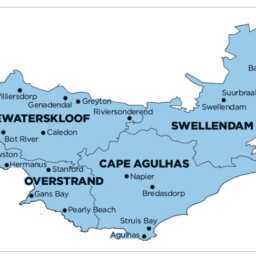
According to official municipal figures (Community Services, June 2025), there are 3,078 informal households in “recognized” informal settlements where communal taps and toilets are actively serviced. Yet the municipality’s own internal reports (Water Services, 2024/2025) document an additional 7,284 shacks on occupied land. Separate municipal estimates (Human Settlements / Housing Waiting List) cite a further 5,050 backyard dwellings.
Is this backyard count in addition to the 10,000+ informal households? The official record isn’t clear. But even under the most conservative interpretation, at least one in every four households in the Overstrand lives in a shack. Let that sink in.
By applying the municipality’s standard planning metric of 4 people per household, Water Services projects an informal population of 41,608 residents. That means more than 27% of the entire Overstrand population lives in informal conditions.
| Geographic Region (Water Services Scope) | Informal Households (Settlements + Backyards) | Projected Informal Population (1:4 Ratio) |
| Greater Hermanus (Zwelihle, Hawston, Mount Pleasant) | 8,343 | 33,372 |
| Kleinmond (Overhills, Proteadorp, Ext 6) | 1,108 | 4,432 |
| Greater Gansbaai (Masakhane, Blompark, Eluxolweni) | 540 | 2,160 |
| Stanford (Stanford South) | 267 | 1,068 |
| Pearly Beach | 128 | 512 |
| Buffeljags Bay | 16 | 64 |
| Total Overstrand Informal Footprint | 10,402 | 41,608 |
Whoever is to blame for this state of affairs, it is the reality we face today. It is the single biggest threat to long-term political and economic stability in our region—and we can no longer afford to pretend otherwise.
The Math: Why Township Upgrading Benefits Every Ratepayer
For decades, suburban ratepayers have viewed informal settlements primarily through the lens of financial burden, crime risk, or property devaluation. It is time to completely flip that logic.
Under the status quo, a shrinking pool of suburban ratepayers carries almost the entire municipal tax burden. As regional infrastructure demands accelerate, that means higher rates, steeper utility tariffs, and mounting financial pressure on every homeowner in Hermanus and elsewhere in the Overstrand.
Upgrading these communities isn’t a charity project; it is the most powerful economic growth strategy available to secure the Overstrand’s financial future:
- Expanding the Ratepayer Base: Replacing thousands of informal shacks with formal, titled housing doesn’t necessarily drain municipal coffers—it adds thousands of new, contributing ratepayers. That spreads the financial load, generates reliable service revenue, and stabilises rates for everyone.
- Capitalizing on Local Commerce: When informal areas are formalised, home improvement markets, local construction, neighbourhood retail, and personal banking flourish. Integrating township enterprises into the formal regional supply chain expands the broader commercial tax base.
- Protecting Suburban Property Values: Unserviced informal growth leads to illegal utility connections, environmental runoff, and social volatility. Formalising and servicing these areas builds regional stability, safety, and long-term property value appreciation across every ward.
What Are We Going to Do About It?
Continuing to ignore this demographic and structural shift is a missed economic opportunity of massive proportions. Real political leadership isn’t about telling rate-paying voters comfortable stories to protect a stagnant tax base; it is about explaining how expanding that tax base secures the entire region’s economic future.
We need to stop asking candidates how fast they will fix a suburban street light, and start asking how they plan to turn informal settlements into viable, rate-paying, economically integrated suburbs.
What do you think?
Comments