
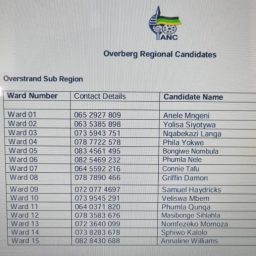













Opinion by Gerard Grobler/Whalecoastreport
HERMANUS – The narrative that the Overstrand is a safe, untouchable stronghold for the Democratic Alliance (DA) is about to face its toughest test.
Behind the facade of pristine coastal roads and award-winning municipal management lies a shifting mathematical reality: the DA is walking an electoral tightrope, sitting roughly 1,200 to 1,500 votes away from losing its outright majority.
For the upcoming local government elections, a convergence of socio-economic pressures, new political forces, and ratepayer friction threatens to drag the Overstrand into the same coalition environment that now governs much of the Western Cape.
The New Math: Why 15 Is the Only Number That Matters
When voters head to the polls on November 4th, they will be electing an expanded 29-seat municipal council (up from 27). To govern alone, a party must secure an absolute majority of 15 seats.
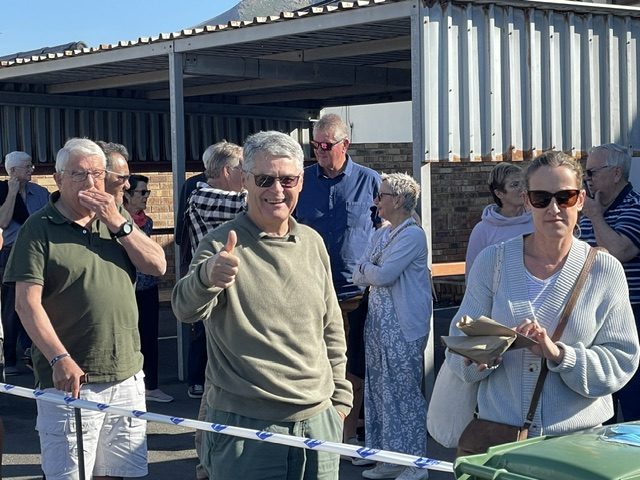
In 2021, the DA won 17 seats with 53.3% of the vote. While an outright majority looks comfortable on paper, that 53.3% translated to roughly 14.4 seats’ worth of raw proportional support. Dominating 10 of the 14 individual wards provided the extra boost needed to secure 17 seats.
In a 29-seat council, the bar rises. A party needs at least 51.8% of the total vote share to guarantee 15 seats. The DA’s cushion above that line is a razor-thin 1.5 percentage points—which works out to a buffer of just 80 to 90 voters per ward.
The Forces Chipping Away at the Majority
The DA does not need to suffer a major collapse to fall to 14 seats. Instead, it faces a “death by a thousand cuts” from multiple directions:
Socio-Economic Strain & Ratepayer Squeeze: Across traditional working-class and suburban bases alike, frustration is mounting over year-on-year, above-inflation increases in municipal accounts, electricity tariffs, and service charges. In a region with a significantly higher proportion of retirees and fixed-income pensioners than the national average—compounded by young families struggling with soaring living costs and inflated local housing rents—the financial pressure is acute. This economic pinch is quietly eroding historical loyalty, leaving many voters open to protest options.
The Patriotic Alliance Surge in Working-Class Wards: The PA has consistently disrupted rural Western Cape elections, pulling significant swings directly from the DA and ANC. In Wards 8 (Hawston), 14 (Blompark) and 9 (Proteadorp) even a modest PA vote surge drains the DA’s overall municipal PR vote pool.
Conservative Growth (VF Plus): There is little doubt that support for the VF Plus will grow substantially—driven by discontent over property rates, service tariffs, and demands for greater regional autonomy. It doesn’t require winning wards outright. Siphoning off PR votes in Sandbaai, Onrus, Hermanus, Kleinmond, and Gansbaai converts directly into 3 or 4 PR seats for the VF Plus.
The Rise of Ward Independents: Seven independent candidates are contesting local wards. These localized candidates split the ward vote in suburban strongholds, siphoning off DA support even further, and while unlikely, it is not impossible for them to manage a proportional seat.
The Land Party & Township Realignment: In Zwelihle (Wards 5, 6, 12) and Thembelihle (Stanford), the Land Party apparently continues to absorb former ANC support. As their ground team drives higher voter turnout in high-density areas, they lift the overall vote quota required to win seats across the entire municipality. The simple fact is that black South Africans are now the single largest population grouping in the Overstrand, according to official statistics some 38% of the total population.
Many traditional DA voters adopt a split-vote strategy: voting DA on the ward ballot to secure a reliable local councillor, but voting VF Plus or Independent on the PR ballot to send a message about municipal rate hikes and other grievances.
Under South Africa’s Mixed-Member Proportional (MMP) rules, both ballots are added together to determine total council seats. When 1,200 suburban voters split their ballots, the DA’s municipal vote total drops, directly costing them 1 or 2 PR seats.
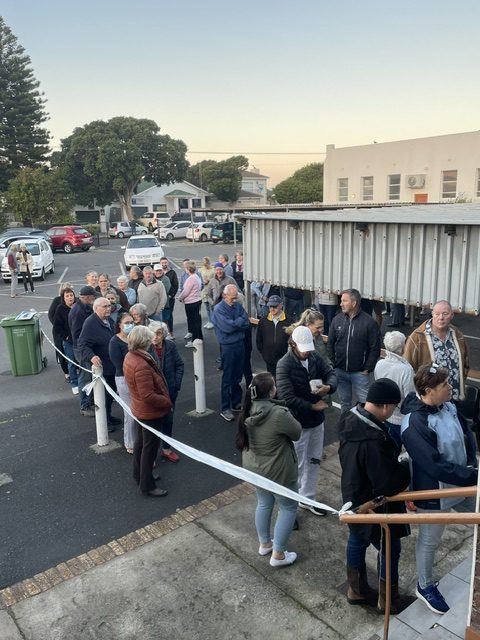
The Coalition Reality: What Happens at 14 Seats?
If the DA falls to 14 seats, single-party control ends instantly. To reach the 15-seat threshold needed to pass budgets and elect a mayor, the DA would be forced to negotiate:
DA + VF Plus (Most Likely): A center-right alliance trading Mayoral Committee portfolios for a stable governing coalition.
DA + ACDP or Independent (High-Risk): A 1-seat buffer that leaves council business vulnerable whenever a single councillor is absent or breaks rank.
The “Anti-DA” Alternative: A broad opposition front uniting the Land Party, ANC, PA, and EFF to form a minority or majority bloc—a scenario similar to hung councils in Knysna or Beaufort West.
The Battle for 1,200 Votes
To counter these localized pressures, the DA relies heavily on a strategy of anxiety—framing the election not on its local tariff policy, but as a defense against chaos.
Speaking at a recent DA party function, Western Cape Local Government Minister Anton Bredell captured this campaign framing, citing a firefighter adage that there is a very short distance between “it’s okay” and “oh shit.” Pointing to the administrative fallout in Knysna, Bredell warned that the leap from “it’s okay” to “Oh, Knysna” can happen in an instant.
For the DA, this “Knysna warning” is their ultimate net to catch defecting voters. For opposition parties and independents, however, it is dismissed as scaremongering designed to deflect from rising rates, living costs and a serious lack of public participation in important decisions.
Whether fear of instability overrides local financial and political grievance will decide the November 4th result. A shift of just 80 votes per ward determines whether the Overstrand remains under single-party DA rule or enters unchartered coalition territory.

What do you think?
Comments